Government Jobs After Graduation: Best Exams and Career Options
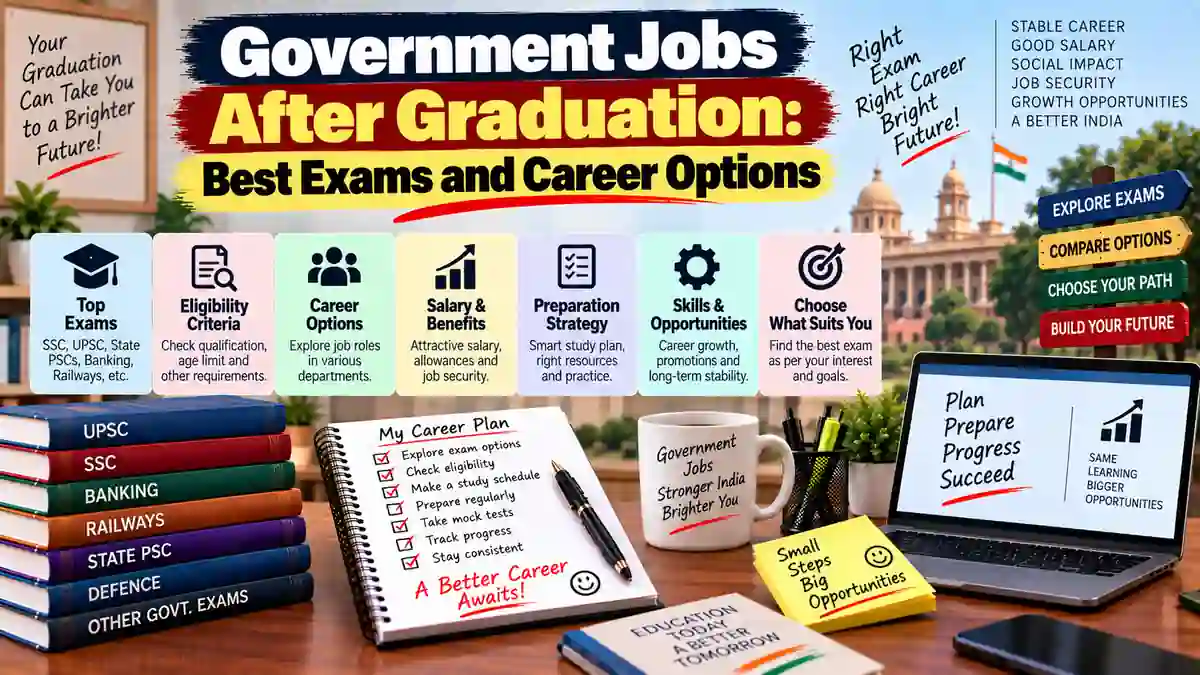
Graduation changes the government-job landscape considerably. Once you have a recognized bachelor's degree, you can consider recruitment categories that are not available to candidates with only 10th or 12th qualification.
The choice is much wider than simply preparing for one popular examination. Depending on your degree, age, interests and preferred work environment, you can explore central government services, SSC examinations, railways, banking, defence, state government services and specialist recruitment.
Best Government Exams After Graduation
| Exam / Recruitment Area | Suitable For | Career Direction |
|---|---|---|
| SSC CGL | Graduates looking for central government Group B and Group C posts | Central ministries, departments and government offices |
| UPSC Civil Services | Graduates targeting administrative and other civil services | IAS, IPS, IRS and other services included in the examination |
| UPSC CDS | Graduates interested in officer entry into the Armed Forces | Defence officer careers through eligible entries |
| Banking Exams | Graduates interested in public-sector banking careers | Probationary officer, clerical/customer service and specialist roles depending on the examination |
| Railway Graduate Recruitment | Graduates interested in railway careers | Graduate-level NTPC and other recruitment categories |
| State PSC Exams | Graduates wanting state government careers | State administrative and departmental services |
| Specialist Recruitment | Graduates with specific professional or technical qualifications | Technical, legal, financial, medical and other specialized positions |
This is not a fixed list of all graduate-level opportunities. Recruitment calendars, posts and eligibility conditions change, so the latest notification from the relevant authority should be checked before applying.
SSC CGL: A Major Option for Graduates
The Staff Selection Commission's Combined Graduate Level examination is one of the main routes into central government employment for graduates. SSC currently lists CGL among its major examinations, along with several other recruitment examinations.
SSC CGL recruitment can lead to various Group B and Group C positions in central government ministries, departments and organizations. The exact posts, vacancies and requirements depend on the examination cycle.
This exam can suit candidates who prefer an office-based government career and are comfortable preparing subjects such as quantitative aptitude, reasoning, English and general awareness.
There can also be post-specific requirements. For example, certain statistical positions have additional educational conditions, so a candidate should not assume that every CGL post has identical eligibility.
UPSC Civil Services Examination
Graduates who want to pursue higher-level administrative careers can consider the UPSC Civil Services Examination. The examination covers services including the Indian Administrative Service, Indian Police Service and Indian Revenue Service, among others.
The basic educational requirement for the Civil Services Examination is a recognized degree or an equivalent qualification, subject to the conditions in the applicable examination rules.
The UPSC examination is considerably different from exams such as SSC CGL. It requires preparation for the Preliminary Examination, Main Examination and interview/personality test stages. UPSC's current examination listings show Civil Services as an active examination category.
If your goal is civil administration rather than simply securing any government job, UPSC deserves a separate preparation strategy and a longer-term study plan.
Government Banking Jobs After Graduation
Graduation also opens the door to several banking recruitment examinations. IBPS conducts common recruitment processes for participating banking organizations, including recruitment for Probationary Officer/Management Trainee, Customer Service Associate and Regional Rural Banks, along with specialist officer recruitment.
Banking can be a good fit for graduates who prefer customer-facing, administrative or financial work. Specialist banking positions can have much more specific qualification requirements. For instance, IBPS specialist officer recruitment can require qualifications such as engineering degrees, law degrees or postgraduate qualifications depending on the post.
Therefore, a general graduate and a candidate with an engineering, agriculture, law or other professional qualification should not necessarily follow the same banking preparation route.
Railway Jobs After Graduation
Railway recruitment is another important category for graduates. The Railway Recruitment Boards have separate recruitment categories for undergraduate and graduate NTPC posts, along with technical, Level 1 and other recruitment. The RRB recruitment notices list CEN 06/2025 for NTPC-Graduate posts and separate notices for other categories.
Graduate-level railway recruitment can be suitable for candidates who want a large government organization with different operational, commercial and office-related roles.
Check the post-wise qualification carefully. A graduate-level railway recruitment does not mean that every post has exactly the same eligibility or skill requirement.
Candidates interested specifically in railway opportunities can also explore the railway jobs category for relevant updates.
Defence Officer Opportunities After Graduation
Graduates interested in defence careers can explore examinations such as the UPSC Combined Defence Services examination, subject to the eligibility requirements of the particular entry.
UPSC's current examination schedule includes the Combined Defence Services Examination along with Civil Services and other specialized examinations.
Defence recruitment is different from a typical office-based government examination. Candidates may have to clear written, selection or assessment stages as well as medical and physical requirements, depending on the entry.
If you are considering defence as your primary career, include physical fitness in your preparation from the beginning rather than treating it as a final-stage requirement. Candidates preparing for posts involving physical standards can also read how to prepare for a government job physical test.
State Government Jobs After Graduation
Every state has its own recruitment system, commissions and departments. State Public Service Commission examinations can provide opportunities in administrative and departmental services, while other recruitment boards handle specific categories of posts.
State government recruitment may be attractive if you prefer working within your home state. At the same time, state-specific eligibility can include requirements relating to language, domicile, age and other conditions.
Do not compare a state PSC examination with a central government examination only by salary. The examination pattern, posting possibilities, job duties and career progression can be quite different.
You can explore the state government jobs category for state-level opportunities or the Gujarat government jobs category if you are interested in Gujarat recruitment.
Government Jobs Based on Your Graduation Subject
Your degree subject can affect which recruitment options are worth considering.
| Graduation Background | Areas Worth Exploring |
|---|---|
| Any recognized bachelor's degree | SSC CGL, UPSC Civil Services, selected banking, railway and state-level examinations |
| Engineering | Technical recruitment, engineering services, specialist banking roles and general graduate-level exams |
| Commerce | Banking, accounts, finance-related recruitment and general graduate-level examinations |
| Science | General graduate recruitment plus subject-specific scientific, technical or statistical opportunities where eligible |
| Law | Legal officer and other law-specific government recruitment |
| Agriculture | Agriculture-related government and banking specialist recruitment |
| Medicine / Allied fields | Medical and health department recruitment requiring the relevant professional qualification |
This does not mean that your graduation subject limits you to these careers. Many major competitive examinations accept graduates from different academic backgrounds, while specialist posts may impose specific qualification requirements.
How to Choose the Right Government Exam
Graduates often face the opposite problem from 10th or 12th-pass candidates: there are too many choices.
Start by deciding what type of career you actually want. You can also read how to choose the right government exam for your career before making a final decision.
- Administrative career: Consider UPSC Civil Services and relevant State PSC examinations.
- Central government office career: SSC CGL and similar graduate-level recruitment may be relevant.
- Banking career: Explore IBPS and other public-sector bank recruitment applicable to your qualification.
- Railway career: Track RRB graduate-level and other eligible recruitment.
- Defence career: Explore CDS and other graduate-level defence entries for which you qualify.
- Technical career: Focus on recruitment matching your engineering or technical discipline.
- Specialist career: Look for vacancies requiring your specific professional qualification.
Compare Exams Before Starting Preparation
| Factor | Why It Matters |
|---|---|
| Syllabus | Helps you estimate how much preparation is required |
| Selection stages | Written examination, skill tests, interview and other stages require different preparation |
| Job duties | A government job can be office-based, field-oriented, technical or public-facing |
| Posting | Consider whether you are comfortable with transfers or working outside your preferred location |
| Age limit | Important because each recruitment has its own cut-off date and relaxation rules |
| Qualification | Specialist posts may require a particular degree or subject |
| Preparation overlap | Similar syllabi can allow one preparation plan to cover multiple examinations |
Should You Prepare for Multiple Government Exams?
Yes, but choose them carefully.
Preparing simultaneously for SSC CGL, a banking examination and a railway examination can make sense when their core subjects overlap. You can build a common foundation in reasoning, quantitative aptitude, English and general awareness and then adjust your preparation for each examination.
On the other hand, adding UPSC Civil Services to the same plan requires a significantly different approach because of its breadth and Main Examination requirements. Treating every government exam as if it has the same syllabus can lead to an unfocused preparation schedule.
If you decide to combine compatible exams, follow a structured approach to preparing for multiple government exams.
A Practical Preparation Strategy for Graduates
Once you have selected your target examinations, start with the subjects common to most of them.
- Read the official syllabus: Do not build your study plan from random coaching lists.
- Attempt previous-year papers: This gives you a better idea of question level and recurring topics.
- Identify weak areas: Spend more time on subjects where your accuracy or speed is poor.
- Practice regularly: Competitive exams require both knowledge and time management.
- Use mock tests strategically: Analyze mistakes rather than simply recording your score.
- Follow current affairs according to the exam: The depth and relevance can vary between examinations.
- Prepare examination-specific sections: Add specialist subjects, descriptive papers, typing or other requirements where applicable.
For a more detailed preparation structure, you can use the government job preparation strategy and government job exam study plan guides.
Do Previous-Year Papers Really Matter?
They are one of the most useful preparation resources because they show you what the recruiting authority actually asks rather than what a generic preparation article claims it might ask.
Use them to identify:
- Frequently tested topics
- Question difficulty
- Time pressure
- Types of reasoning and quantitative questions
- Language question patterns
- Subject-specific areas
After solving a paper, spend time reviewing incorrect answers. A mock score without error analysis tells you much less than a detailed review of why you lost marks.
Read how to use previous-year papers for government exam preparation for a practical method.
Government Job Preparation Alongside a Private Job
Not every graduate can study full-time. If you are already working, choose your target examinations with your available preparation time in mind.
Exams with overlapping syllabi can be easier to combine with a job. A realistic weekday schedule might focus on one or two core subjects, while weekends can be used for full-length papers and revision.
For a long examination cycle such as UPSC Civil Services, the preparation approach will naturally be different from preparing for a recruitment test with a narrower syllabus.
A realistic timetable can be built using the government exam study timetable approach. If you are unsure about daily study hours, see how many hours to study for a government exam.
Documents Graduates Should Keep Ready
Keep the following documents organized before recruitment applications begin, wherever applicable:
- Graduation marksheets
- Degree or provisional certificate
- Class 10 certificate for date-of-birth verification where required
- Valid identity document
- Recent photograph and signature
- Category certificate, if applicable
- Disability, ex-serviceman or other applicable certificates
- Professional registration or qualification documents for specialist posts
Do not assume that every recruiting authority asks for the same documents at the same stage. Read the application instructions and document-verification requirements for the specific recruitment.
Before applying, review the documents required for a government job application and the correct way to fill a government job online application form.
Common Mistakes Graduates Should Avoid
- Preparing for too many exams: A long list of targets can dilute your preparation.
- Choosing an exam only because it is popular: The job itself should suit your interests and strengths.
- Ignoring the exact eligibility: A general graduation qualification does not satisfy every specialist post.
- Using an old syllabus: Check the current examination notification.
- Skipping previous-year papers: They are useful for understanding the actual examination.
- Focusing only on cutoff marks: Your preparation should aim for strong accuracy and consistency rather than merely crossing a historical cutoff.
- Ignoring job duties: A post that looks attractive on paper may involve transfers, field work or public dealing that you may not prefer.
You can also review these common government job preparation mistakes before finalising your study routine.
What If You Have a Professional Degree?
A professional qualification can give you two routes: general graduate-level examinations and specialist recruitment.
For example, an engineer can choose between general competitive examinations and technical posts. A law graduate can consider general examinations as well as legal recruitment. Similarly, candidates with agriculture, medical, finance or other specialized qualifications can look for vacancies where their subject is specifically required.
Specialist recruitment can have very precise eligibility conditions. IBPS specialist officer recruitment, for example, specifies different educational qualifications for different specialist posts.
Frequently Asked Questions
Which government exam is best after graduation?
There is no universal best exam. SSC CGL, UPSC Civil Services, banking, railway, defence and State PSC examinations suit different career goals. The right choice depends on the type of work, examination pattern and eligibility that fits you.
Can graduates from any stream apply for SSC CGL?
Many CGL posts use graduation as the basic qualification, but some posts have additional educational requirements. Candidates should check the current SSC notification and post-wise eligibility before applying.
Is UPSC only for specific graduation subjects?
No. The Civil Services Examination's basic educational qualification is a recognized degree or equivalent qualification, subject to the examination rules. Candidates do not generally need a specific bachelor's subject simply to meet the basic degree requirement.
Can I prepare for SSC and banking exams together?
Yes, if you plan carefully. Several core subjects overlap, although the question style, examination structure and some topic requirements differ. Use a common foundation and then practice according to each examination.
Are railway jobs available for graduates?
Yes. RRB recruitment includes graduate-level categories such as NTPC-Graduate recruitment. The exact posts and eligibility depend on the relevant Centralized Employment Notice.
Should I choose a government job based on salary?
Salary is one factor, but it should not be the only one. Job duties, posting, transfers, working hours, physical demands, promotion opportunities and your own career preferences should also be considered.
Choose the Exam That Fits Your Career Plan
Graduation gives you a wider choice, but that choice becomes useful only when you narrow it down intelligently. Start with the type of career you want, identify the examinations that lead toward it, and then compare eligibility, syllabus and selection stages.
For most graduates, the strongest approach is to maintain a small group of compatible targets rather than chasing every notification. Keep checking the official recruiting authority for the latest rules and use previous-year papers to make your preparation more realistic.