What to Do If Your Mock Test Scores Are Not Improving
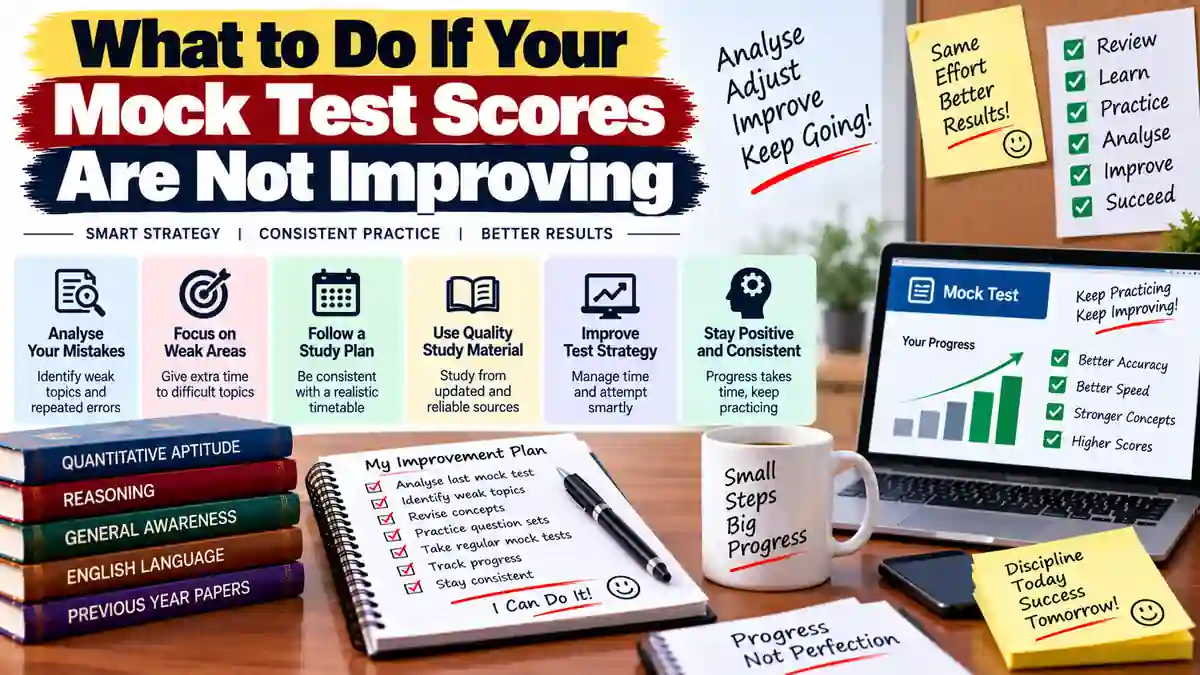
Taking mock tests regularly but seeing almost the same score every time can be frustrating. However, a stagnant score usually gives you useful information about your preparation. The problem may not be that you need more mock tests. You may need to change what you do between two tests.
If your score has remained nearly unchanged across several mocks, stop for a moment and examine your mistakes, section-wise performance, accuracy, question selection and time management.
First, Find Out Why Your Score Is Stuck
Look at your last few mock tests together instead of judging yourself from one result. Check whether the same problem appears repeatedly.
| Problem | What It May Indicate |
|---|---|
| Many questions are wrong | Concept or accuracy problem |
| Too many questions are left | Speed or time-management problem |
| Attempts are high but score is low | Accuracy or question-selection problem |
| One section remains consistently weak | Insufficient topic preparation |
| Easy questions are missed | Careless mistakes or poor question selection |
| Score changes greatly between mocks | Inconsistent preparation or difficulty-level differences |
This analysis should come before deciding to simply increase the number of tests.
Check Your Accuracy
Score alone does not tell the complete story. Compare the number of questions attempted with the number answered correctly.
For example, suppose your first mock has 70 attempts with 55 correct answers and your next mock has 80 attempts with 54 correct answers. Your attempts increased, but your accuracy became worse. Simply trying to attempt even more questions may not improve your score.
Look for a balance between attempts, accuracy and time.
Classify Every Wrong Answer
Do not treat all incorrect answers as the same type of mistake. Divide them into categories.
- Concept mistake: You did not know the correct method or rule.
- Calculation mistake: You knew the method but made an arithmetic error.
- Reading mistake: You misunderstood what the question was asking.
- Guessing mistake: You selected an answer without enough confidence.
- Time-pressure mistake: You rushed because the clock was running out.
- Careless mistake: You knew the answer but marked or calculated it incorrectly.
Once you know which category appears most often, your next study session becomes much easier to plan.
Look at Questions You Got Wrong Because of Concepts
If you cannot explain why the correct answer is correct, the problem is probably not the mock test. You need to revise the underlying topic.
For example, if you repeatedly get questions from a particular mathematics chapter wrong, return to the basic concepts, formulas and solved examples before attempting another large mock.
The same applies to reasoning rules, grammar concepts and factual subjects.
Review Questions You Got Correct by Guessing
A correct answer is not always evidence that you know the topic. Mark the questions where you guessed the answer or reached it through an uncertain elimination process.
These questions are worth reviewing because the same topic may become a mistake in the actual examination.
Your analysis should therefore include three groups:
- Wrong answers
- Correct answers obtained by guessing
- Questions you could not attempt
Find the Topics Behind Your Mistakes
After classifying your mistakes, identify the topics responsible for them. You may discover that several different questions are actually pointing to the same weakness.
| Repeated Problem | Next Action |
|---|---|
| Percentage questions | Revise percentage concepts and solve a focused set |
| Syllogism errors | Review the rules and practice similar questions |
| Grammar errors | Revise the relevant grammar rule |
| Slow calculations | Practice calculations under a time limit |
| General awareness recall | Revise notes and use short quizzes |
Do Not Take Another Mock Immediately
One of the most common reactions to a disappointing score is to take another mock immediately. This may not solve the problem.
If the same weaknesses caused the first result, they are likely to appear again in the second test.
Instead, spend some time fixing the most important mistakes before taking the next full-length mock.
Use Targeted Practice Between Mocks
Replace some full mocks with focused practice. If your analysis shows that a particular topic is responsible for many errors, solve a dedicated set from that topic.
For example:
- Identify a weak topic from the mock.
- Revise the concept.
- Solve 20–30 questions from that topic.
- Review the mistakes.
- Repeat with another set after a few days.
- Test the topic again in a later mock.
This creates a connection between mock-test analysis and actual improvement.
Check Whether Time Management Is the Real Problem
Sometimes candidates know enough to score well but cannot finish the paper. Check how many questions you leave because of lack of time.
Also look at the questions that consumed the most time. If you spent several minutes on questions that produced no marks, your problem may be question selection rather than overall speed.
Learn to Leave Time-Consuming Questions
A difficult question is not necessarily a question you should solve immediately. If the solution is unclear or the calculation is becoming lengthy, move forward when the exam format allows it.
Return to such questions later if enough time remains.
This simple habit can sometimes improve your score without requiring you to learn an entirely new topic.
Check Your Section-Wise Scores
A total score can hide a major weakness. Compare your performance in each section across several mocks.
| Section | Mock 1 | Mock 2 | Mock 3 |
|---|---|---|---|
| Reasoning | — | — | — |
| Quantitative Aptitude | — | — | — |
| English | — | — | — |
| General Awareness | — | — | — |
If one section consistently performs below the others, give it more targeted study time rather than simply taking more full-length tests.
Check Whether You Are Practicing at the Right Level
Very easy practice questions can make you feel prepared while doing little to improve your performance on exam-level questions. On the other hand, extremely difficult questions can consume time without being representative of your target examination.
Use previous-year questions and realistic mock tests to understand the level you actually need to handle.
Compare Mocks Carefully
Do not assume that a lower score always means your preparation has become worse. Mock papers can vary in difficulty.
Along with the score, compare accuracy, attempts, time taken and section-wise performance. A slightly lower score on a harder paper may still represent an improvement in your ability.
Set One Improvement Target for the Next Mock
Instead of trying to improve everything at once, choose one or two measurable targets.
For example:
- Reduce calculation mistakes in mathematics.
- Increase accuracy in reasoning.
- Leave lengthy questions earlier.
- Improve attempts without reducing accuracy.
- Reduce the number of guessed answers.
After the next mock, check whether that specific target improved.
Use a Mock Test Improvement Sheet
A simple tracking sheet can make stagnant scores easier to understand.
| Metric | Current Result | Next Target |
|---|---|---|
| Total attempts | — | — |
| Correct answers | — | — |
| Incorrect answers | — | — |
| Unattempted questions | — | — |
| Time remaining | — | — |
| Main weak topic | — | Revision required |
Keeping this record for several tests can reveal patterns that are difficult to notice when you only look at the final score.
Give Revision Enough Time to Work
After identifying a weak area, do not expect the score to jump in the very next test automatically. Some concepts need repeated practice before they become reliable under exam pressure.
Give yourself enough time to revise, practice and retest the topic.
Do Not Copy Someone Else's Mock Strategy
You may see candidates taking multiple mocks every day or attempting a very high number of questions. Their strategy may not suit your preparation level or target examination.
Build your routine around your own accuracy, available study time and weaknesses.
Reduce Mock Frequency if Analysis Is Being Ignored
If you are taking four or five mocks a week but barely reviewing them, consider reducing the number. Use the saved time for mistake analysis and targeted practice.
A smaller number of well-analyzed tests can provide more useful feedback than a large number of tests treated as routine.
When Should You Increase Mock Frequency Again?
Once your major weaknesses have been addressed, gradually increase full-length testing again. Your new mocks should show whether the improvements work under exam-like conditions.
If the same problem returns, go back to targeted practice rather than simply increasing the mock count.
A Practical Reset Plan for Stagnant Scores
If your scores have not improved for several tests, try this reset:
- Review your last three to five mock tests.
- Identify your three most frequent mistakes.
- Find the topics behind those mistakes.
- Pause unnecessary full-length testing for a short period.
- Revise the weak topics.
- Complete targeted question sets.
- Practice the areas under time pressure.
- Take another full mock.
- Compare the new results with your previous performance.
Do Not Judge Your Preparation From One Score
A single low score can happen because of fatigue, a difficult paper, unfamiliar questions or a poor day. Look at performance across multiple tests before making major changes to your preparation.
What matters more is whether you are gradually reducing repeated mistakes, improving accuracy, handling time better and becoming more consistent.
Turn Every Mock Into a Study Tool
A mock test should do more than tell you your current score. It should tell you what to study next.
If your score is stuck, the solution is usually not to chase a higher score immediately. Find the reason behind the stagnant performance, work on the specific weakness and then test yourself again.
Once each mock becomes part of this cycle—test, analyze, revise, practice and retest—your preparation becomes much easier to measure and improve.