Government Jobs After 12th: Best Options for Freshers
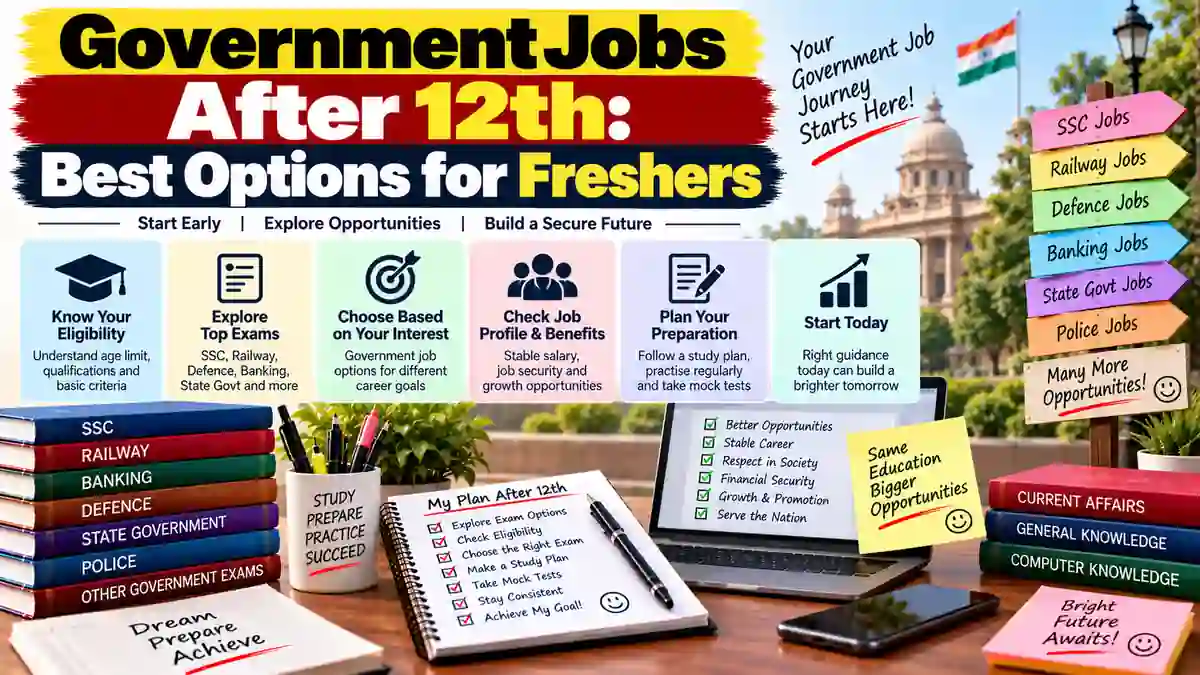
Completing Class 12 gives freshers access to several government recruitment categories without requiring a college degree. The right option depends on your stream, age, typing or computer skills, physical fitness and the kind of work you want to do.
For a fresher, the useful approach is not to search for a single "best" government job. Instead, identify a few recruitment categories for which you are eligible and compare their exams, job duties and career path. You can also find government jobs based on your qualification before choosing your targets.
Popular Government Job Options After 12th
| Recruitment Area | Suitable For | Typical Selection Stages |
|---|---|---|
| SSC | 12th-pass candidates interested in central government clerical and related posts | Computer-based examination and skill/typing test where prescribed |
| Railways | Candidates interested in railway office, commercial and other eligible posts | Varies by recruitment; may include CBT, skill test and document verification |
| Defence | Candidates interested in uniformed and physically active careers | Varies by entry; may include written, physical, medical and other stages |
| Police | Candidates interested in state police and field-oriented work | Usually includes written and physical stages, depending on the state/post |
| State Government | Candidates looking for employment within their state | Depends on the recruiting department and post |
| Postal and other departments | Candidates meeting the qualification specified for individual vacancies | Varies according to recruitment rules |
The table is only a starting point. Recruitment notifications can change the qualification, age limit, examination pattern and other requirements, so the individual notification should always be checked before applying.
SSC Jobs After 12th
The Staff Selection Commission is one of the major recruitment authorities that 12th-pass candidates should track. One of the best-known routes is the SSC Combined Higher Secondary (10+2) Level examination.
SSC CHSL recruitment has included posts such as Lower Divisional Clerk/Junior Secretariat Assistant, Postal Assistant/Sorting Assistant and Data Entry Operator. The exact posts and vacancies depend on the relevant examination cycle.
For office-oriented candidates, this can be an attractive category because the work is generally different from physically demanding field jobs. Candidates should also be prepared for the typing or skill requirements applicable to the post.
If you are considering SSC preparation, you can also review government job preparation strategies and build a study routine around the actual examination syllabus.
Railway Jobs After 12th
Railway recruitment includes both undergraduate and graduate-level categories. Candidates who have completed 12th should pay attention to notifications where higher secondary education is the prescribed qualification.
Railway NTPC undergraduate recruitment has historically covered posts such as Junior Clerk cum Typist, Accounts Clerk cum Typist, Trains Clerk and Commercial cum Ticket Clerk, subject to the conditions of the relevant recruitment cycle.
Typing requirements can be particularly relevant for clerical posts. A candidate who starts practicing typing before the recruitment process reaches the skill-test stage can avoid having to learn it at the last minute.
You can keep track of relevant opportunities through the Railway Jobs category.
Defence Jobs After 12th
Defence services offer several routes after Class 12, but eligibility depends heavily on the entry. Some entries require particular subjects in Class 12, while others have different educational and physical requirements.
For candidates interested in defence careers, check these points carefully:
- Whether your Class 12 stream and subjects meet the requirement
- Age eligibility for the specific entry
- Physical standards
- Medical requirements
- Written examination pattern
- Selection interview or assessment stages, where applicable
- Training requirements
Do not select a defence entry solely because the notification says "12th pass". Some posts require specific subjects such as Physics, Chemistry or Mathematics, depending on the entry.
If your target recruitment includes a physical stage, read how to prepare for a government job physical test as part of your preparation.
Police Jobs After 12th
State police recruitment is another area worth considering after Class 12. Constable and other posts are advertised by individual state police departments according to their recruitment rules.
Police recruitment can suit candidates who are comfortable with field duties and physical tests. The selection process may include a written examination, physical measurement, physical efficiency test, medical examination and document verification, although the exact sequence differs between recruitments.
Before preparing, check the official notification for your state rather than relying on eligibility information from another state.
State Government Jobs After 12th
State governments recruit for different departments and posts, including clerical, support, field and technical positions. The eligibility can depend on the department, state rules and the specific recruitment board.
State-level opportunities can be particularly useful if you have a strong preference for working within your state. However, some recruitments may have requirements relating to local language, domicile or other state-specific conditions.
Keep an eye on the official recruitment commission, board or department responsible for appointments in your state.
You can also browse the State Government Jobs category and, for Gujarat-specific opportunities, the Gujarat Government Jobs category.
Choosing the Right Government Job as a Fresher
Freshers often make the mistake of choosing a vacancy based only on salary or the popularity of the department. A better comparison includes the actual work, selection process and your own strengths.
| Preference | Recruitment Areas to Consider |
|---|---|
| Office-based work | SSC CHSL, railway clerical and other eligible administrative posts |
| Uniformed service | Police, defence and other uniformed recruitment |
| Field-oriented work | Police, railway and selected departmental posts |
| State-level employment | State government departments and recruitment boards |
| Computer and typing work | Clerical, data-entry and other posts requiring relevant skills |
Before finalising your target, it can help to read how to choose the right government exam for your career.
Check Your Eligibility Before Preparing
Do not wait until the application form opens to discover whether you are eligible. Create a basic eligibility checklist for every recruitment you are considering.
- Qualification: Confirm that your 12th qualification and stream meet the requirement.
- Age: Check the minimum and maximum age using the cut-off date specified in the notification.
- Subjects: Look for subject-specific requirements, particularly in technical and defence entries.
- Typing or skill requirements: Check whether a typing or computer skill test applies.
- Physical standards: Review height, endurance and other requirements for police or defence posts.
- Medical standards: Read the medical requirements where applicable.
- Nationality and other conditions: Check the basic eligibility conditions in the official notice.
- Documents: Confirm which certificates and documents will be needed during application or verification.
Does Your 12th Stream Matter?
Sometimes it does, and sometimes it does not.
Many general recruitment examinations accept candidates who have passed 12th from a recognized board without restricting the stream. Other vacancies specifically require Science, Commerce, Mathematics or another subject combination.
Therefore, do not reject a vacancy simply because you studied Arts, Commerce or Science. First read the educational qualification section of the notification.
Skills That Can Help 12th-Pass Freshers
Your certificate is only one part of your preparation. Certain practical skills can make preparation easier for particular government job categories.
- Typing: Useful for many clerical and data-entry related posts.
- Basic computer knowledge: Helpful for office-oriented recruitment and computer-based examinations.
- Quantitative aptitude: Commonly useful for competitive examinations.
- Reasoning: A regular part of many government recruitment tests.
- English or regional language: Depending on the examination and post.
- General awareness: Often included in competitive recruitment examinations.
- Physical fitness: Essential for recruitment involving physical tests.
For written-exam preparation, you can strengthen areas such as quantitative aptitude, reasoning and English.
How Freshers Should Start Preparation
There is no need to prepare separately for every government examination from the first day. First identify examinations with overlapping subjects.
For example, if two target examinations both contain reasoning, mathematics, English and general awareness, a common study plan can cover much of the preparation. You can then add the examination-specific sections closer to the test.
A practical starting routine is:
- Choose two or three realistic recruitment categories.
- Download and read the latest official notification for each relevant examination.
- Compare their syllabi and selection stages.
- Take a previous-year paper or mock test to identify weak subjects.
- Build your preparation around those common subjects.
- Practice typing separately if your target posts require it.
- Include physical training if you are targeting police or defence recruitment.
- Review official updates regularly once the recruitment cycle begins.
If you are targeting more than one compatible examination, see how to prepare for multiple government exams without losing focus.
Documents Freshers Should Keep Ready
Having your basic documents organized can make online applications much easier.
- Class 10 certificate and marksheet
- Class 12 certificate and marksheet
- Valid identity proof
- Recent photograph
- Scanned signature in the required format
- Category certificate, where applicable
- Domicile or other residence certificate, if required
- Other certificates specifically mentioned in the notification
Keep digital copies in the file format and size required by the application portal. Do not assume that an old photograph or certificate will meet the specifications of every recruitment.
For a detailed checklist, see documents required for a government job online application.
Common Mistakes Made by 12th-Pass Freshers
- Applying for every vacancy: More applications do not necessarily mean better preparation. Choose exams that fit your qualification and career preference.
- Ignoring the syllabus: Starting preparation without checking the actual syllabus often leads to wasted study time.
- Leaving typing practice until the end: Candidates targeting clerical posts should build typing ability early.
- Ignoring physical preparation: Police and defence candidates need to prepare for physical stages from the beginning.
- Following outdated information: Eligibility and examination patterns can change between recruitment cycles.
- Relying only on social media posts: Use them for alerts, but verify important information through the official recruiting authority.
- Ignoring previous-year papers: Previous papers help you understand the actual level and style of questions.
You can also review common government job preparation mistakes and common mistakes while filling government job forms.
Government Job or Further Study After 12th?
This is a decision many freshers face. If you need to start working soon, you can target 12th-level recruitment while continuing to build your skills. If your long-term goal is a wider range of government careers, graduation can open many additional recruitment opportunities.
For example, a candidate interested in administrative or officer-level examinations may find that completing graduation creates substantially more options. Someone interested in technical work may instead consider a diploma or another specialized qualification.
You do not necessarily have to choose between preparation and education immediately. Depending on your circumstances, it may be possible to prepare for eligible examinations while continuing your studies.
If you are considering the longer-term options that graduation provides, see government jobs after graduation.
Frequently Asked Questions
Which government job is best after 12th?
There is no single best job for every 12th-pass candidate. SSC, railways, defence, police and state government recruitment can all be suitable depending on your preferred work, eligibility, physical fitness, location preference and preparation strengths.
Can a fresher apply for government jobs after 12th?
Yes. Many government recruitments are designed for candidates who meet the prescribed educational qualification and do not require previous work experience. However, experience requirements should always be checked in the specific notification.
Can Arts students apply for government jobs after 12th?
Yes, where the recruitment accepts 12th qualification without a specific stream requirement. Some posts, particularly technical or specialized entries, may require particular subjects.
Are railway jobs available after 12th?
Yes. Railway recruitment includes undergraduate-level categories for eligible candidates. The exact posts and qualification requirements depend on the relevant recruitment notification.
Is graduation necessary for SSC government jobs?
Not for every SSC examination. SSC conducts examinations for different educational levels, including recruitment where 12th qualification is sufficient. Always check the eligibility criteria for the particular examination you want to apply for.
What should I prepare first after Class 12?
Start by selecting a small group of suitable examinations, comparing their syllabi and selection stages, and then focusing on overlapping subjects. If your target post has typing or physical requirements, practice those alongside your written-exam preparation.
A Practical Route for Freshers
For a 12th-pass fresher, the most sensible strategy is to keep your options open without preparing for everything at once. Pick a few recruitment categories that match your qualification and preferred type of work, study their official syllabi, and use previous-year papers to understand what the examinations actually demand.
At the same time, think beyond your first government job. If you plan to complete graduation, learn a technical skill or pursue another qualification, that decision can expand your options in future recruitment cycles while you continue looking for suitable 12th-level vacancies.