What Happens After Clearing a Government Job Exam? Complete Selection Process Guide
Clearing a government job examination does not always mean that the recruitment process is finished. Depending on the post, candidates may still have to complete additional stages such as a second written examination, skill test, physical test, interview, document verification or medical examination.
The exact process differs between recruitments. A candidate should therefore understand what the result actually means and follow the official notification and subsequent notices issued by the recruiting organisation.
What Happens After You Clear a Government Exam?
After a candidate qualifies for an examination stage, the recruiting authority normally moves eligible candidates to the next stage according to the applicable recruitment rules.
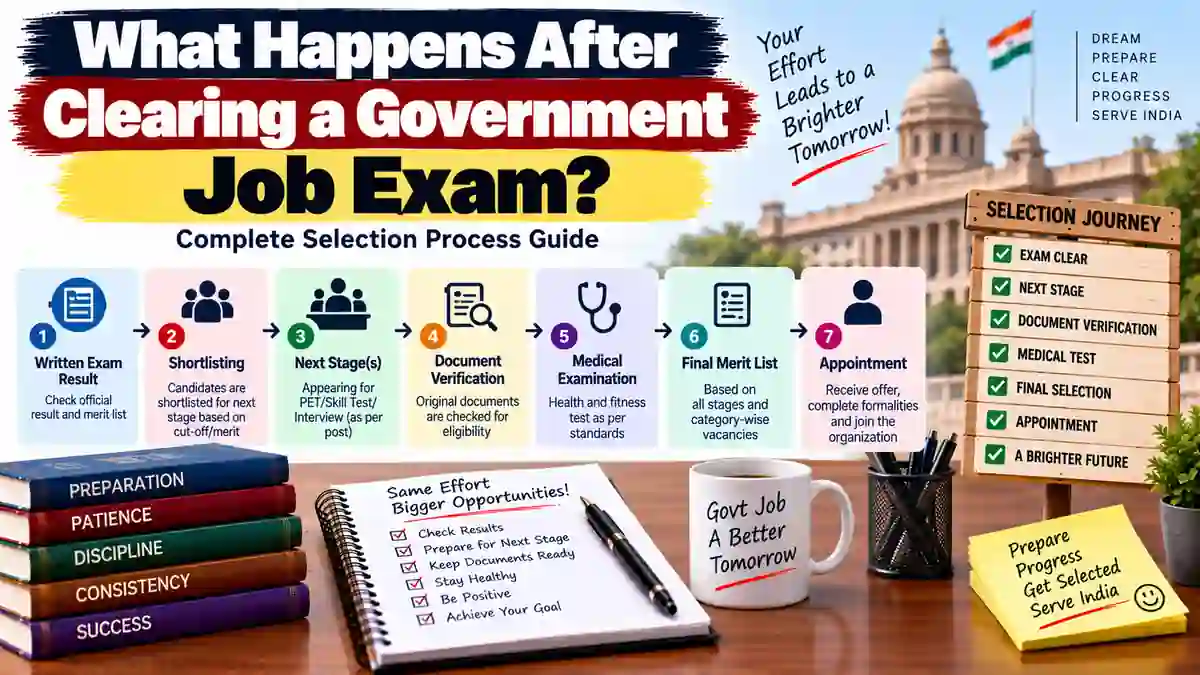
A simplified selection process can look like this:
- Examination result is declared.
- Cut-off or qualifying criteria are applied.
- Shortlisted candidates are called for the next stage.
- Additional tests are conducted where applicable.
- Documents are verified.
- Medical examination may be conducted where required.
- Final merit or selection list is prepared.
- Appointment or joining instructions are issued to selected candidates.
Not every recruitment contains all of these stages. If you want to understand the broader process from result to appointment, this government job selection process guide covers the main stages candidates may encounter.
First, Understand What “Cleared” Means
The word cleared can mean different things depending on the examination. You may have cleared a preliminary examination but still need to appear for the main examination. In another recruitment, clearing the written test may qualify you for a physical or skill test.
Therefore, read the result notice carefully. Look for words such as shortlisted, qualified, eligible for the next stage, provisionally shortlisted or final result.
Government Job Selection Process Can Have Multiple Stages
| Stage | What Usually Happens |
|---|---|
| Written Examination | Candidates are assessed through the prescribed examination |
| Skill Test | Specific job-related skills may be assessed |
| Physical Test | Physical standards or physical efficiency may be checked where required |
| Interview | Candidates may be assessed through an interview where applicable |
| Document Verification | Eligibility and application details are checked against documents |
| Medical Examination | Medical fitness may be assessed where required for the post |
| Final Selection | Selection is made according to the applicable recruitment rules |
| Appointment | Selected candidates receive further joining or appointment instructions |
1. Check the Official Result
Once the result is announced, download it from the official website of the recruiting organisation.
Check your roll number, name or individual scorecard, depending on the result format. If the result is published as a PDF, make sure you are checking the correct post, examination stage and candidate list.
Save a copy of the result for your records. If you need help with checking results, see how to check government exam results online.
2. Check the Cut Off and Your Marks
If the recruiting organisation publishes the cut-off and marks, compare your score with the applicable cut-off.
Remember that meeting a minimum qualifying requirement does not necessarily mean final selection. Some recruitments use a separate shortlisting cut-off for the next stage. You can learn more about this through the guide on how government exam cut-offs are calculated.
3. Find Out What the Next Stage Is
After checking your result, identify the next stage mentioned in the official notice.
Depending on the recruitment, it could be:
- Main examination
- Skill test
- Typing test
- Computer proficiency test
- Physical standard test
- Physical efficiency test
- Interview
- Document verification
- Medical examination
Do not assume that every government job follows the same sequence.
4. Prepare for the Next Examination if Required
Some recruitments have more than one written examination. If you have qualified for the next written stage, continue studying immediately.
Review the syllabus, examination pattern and previous question papers applicable to the next stage. Your preparation may need to change because the difficulty level or subjects can be different from the first examination. Previous-year papers can be used effectively with this guide to government exam preparation using previous-year papers.
5. Prepare for a Skill or Typing Test
For posts where a skill test is part of recruitment, qualifying the written examination is only one step.
If typing speed, computer knowledge, shorthand or another practical skill is tested, start practising according to the standard prescribed in the official notification.
Do not assume that a high written-exam score will compensate for failing a qualifying skill test when the recruitment rules require the test to be passed.
6. Prepare for the Physical Test
Some government posts require candidates to pass physical standards or physical efficiency tests.
Depending on the recruitment, this may involve measurements or activities such as running, walking, jumps, strength exercises or other prescribed events.
Check the official standards and start preparing well before the test date. The exact requirements can differ significantly between departments and posts. Candidates facing a physical stage can also read how to prepare for a government job physical test.
7. Get Ready for Document Verification
Document verification is a major stage in many government recruitments. Candidates may be required to produce original documents and photocopies according to the verification notice.
Common categories of documents can include:
- Identity proof
- Date of birth proof
- Educational certificates
- Marksheets
- Category certificate, where applicable
- Experience certificate, where applicable
- Required photographs
- Other documents specified in the recruitment notice
Do not prepare your documents using a generic list alone. Follow the exact checklist provided by the recruiting organisation. You can also review how to prepare for government job document verification.
8. Compare Your Documents With Your Application
Before document verification, compare the information in your application with your certificates.
Pay attention to:
- Name
- Date of birth
- Educational qualification
- Year of passing
- Marks or percentage where relevant
- Category
- Experience
- Other eligibility information
If you already know about a discrepancy, check the official instructions to understand how it should be handled.
9. Medical Examination Where Applicable
Some government posts require candidates to undergo a medical examination. The purpose and standards depend on the post and the applicable service or recruitment rules.
Do not assume that passing a general health check automatically means you meet the medical standards for a particular post. Follow the requirements specified by the recruiting organisation.
10. Final Merit or Selection List
After the required selection stages are completed, the recruiting authority may publish a final merit or selection list.
The method used to prepare the final list depends on the recruitment. In some examinations, written marks may have a significant role, while in others different stages may be qualifying or marks may be combined according to the prescribed rules.
Read the recruitment notification to understand how final selection is determined.
Shortlisting Is Not the Same as Final Selection
This distinction is important for government job candidates.
| Status | What It Generally Means |
|---|---|
| Qualified in Written Exam | You have met the criteria for that examination stage |
| Shortlisted | You have been selected to proceed to a further stage |
| Document Verification | Your eligibility and documents are being checked |
| Final Selection | You have been selected according to the recruitment's final criteria |
| Appointment | The appointing authority proceeds with the appointment process |
The exact terminology can differ between recruiting organisations.
What Happens After the Final Selection List?
Once the final selection list is published, selected candidates may receive further instructions relating to appointment and joining.
Depending on the recruitment, this can involve:
- Appointment letter
- Joining instructions
- Place of posting
- Reporting date
- Medical or other pending formalities
- Verification or background-related procedures where applicable
- Probation or service-related conditions
The exact procedure depends on the department and service rules.
Keep Checking Official Updates
After clearing an examination, candidates sometimes stop checking the recruitment website because they assume the next step will be communicated separately. This can lead to missed notices.
Continue checking the official website and candidate portal for:
- Next-stage admit cards
- Skill or physical test schedules
- Document verification notices
- Medical examination instructions
- Final result
- Appointment or joining information
You can also keep an eye on Latest Job Updates for recruitment-related updates and new opportunities.
Keep Your Contact Details Updated
If the recruitment portal allows candidates to update contact details, follow the applicable rules and keep your information current. Important communications may be sent through the contact details registered during recruitment.
Do not create a new application simply because you want to change contact information unless the recruiting organisation specifically instructs you to do so.
Do Not Stop Preparing Too Early
A common mistake after clearing the first examination is to take a long break. If another stage is pending, the gap between the result and the next test may be shorter than expected.
Once you know the next requirement, switch your preparation toward that stage. For example, a candidate shortlisted for a typing test should spend time typing rather than continuing to study written-exam topics that are no longer relevant.
What If You Are Not in the Final Selection?
If you clear one stage but do not make the final list, review the recruitment process and your performance before starting the next attempt.
Identify whether the gap came from written marks, a qualifying test, document eligibility, physical performance or another requirement. This gives you a more useful direction than simply increasing study hours without knowing the problem. If written performance was the issue, you can review how to analyze your government exam mock-test score and identify where preparation needs to improve.
Common Mistakes After Clearing a Government Exam
- Assuming that clearing the written exam means the job is confirmed.
- Not reading the next-stage notice.
- Failing to prepare for a skill or physical test.
- Waiting until the document verification date to arrange certificates.
- Ignoring discrepancies in personal or educational details.
- Not checking the official recruitment website regularly.
- Relying entirely on unofficial social media updates.
- Missing the next-stage reporting time or venue.
- Stopping preparation after the first successful result.
What to Do Immediately After Your Result
- Download and save your result.
- Check your marks and applicable cut-off.
- Read the complete result notice.
- Identify the next selection stage.
- Note the next important date.
- Start preparing for the next stage.
- Begin collecting the documents that may be required.
- Continue checking official recruitment updates.
If you are waiting for a result or have just received one, you can also refer to what to do after government exam results are declared.
Keep a Recruitment File
It can be useful to maintain one physical or digital folder containing your recruitment records.
Keep copies of your application form, admit cards, results, scorecards, official notices, certificates and important correspondence where relevant.
When another stage is announced, you will not have to search through old emails, messages or files to find basic recruitment information.
Every Recruitment Has Its Own Process
There is no universal government job selection process. One recruitment may have only a written examination and document verification, while another may include several written papers, a skill test, physical assessment, interview and medical examination.
The safest approach after clearing any government exam is to identify exactly what your result qualifies you for and then follow the official recruitment instructions for the next stage.
Focus on the Next Step, Not Just the Result
Clearing a government exam is an important milestone, but the recruitment may continue through several stages. Check the result carefully, understand whether you have been shortlisted or finally selected, prepare the required documents, and start working on the next stage without unnecessary delay.
Until the recruiting organisation confirms the final selection and subsequent appointment process, treat each stage as a separate requirement and follow the official instructions for your particular recruitment.